
TL;DR:
- Google’s Map Pack runs on three things: relevance, proximity, and prominence. You control two of the three.
- Your Google Business Profile is the single most important asset for local rankings. Treat it like a living, breathing marketing channel.
- Reviews matter more than almost anything else you can do, but velocity and consistency matter more than raw count.
- NAP consistency across directories is boring, foundational work that most businesses skip. Don’t be most businesses.
- Your website still matters for Map Pack rankings. Location pages, on-page SEO, and schema markup all feed into local visibility.
- There are no shortcuts. Keyword-stuffing your business name will get you suspended. The businesses winning in the Map Pack are doing the unsexy work consistently.
Most businesses treat Google’s Map Pack like a lottery. They set up a listing, cross their fingers, and wonder why they never show up when someone searches “plumber near me” or “personal injury attorney in [city].”
It is not a lottery. It is a system. And the businesses that understand how that system works are the ones showing up in those top three spots, getting the phone calls, collecting the direction requests, and signing the clients.
The Map Pack (sometimes called the Local Pack or Google 3-Pack) is the box that appears at the top of Google search results with a map and three business listings underneath. It shows up for virtually every search with local intent. And because it sits above the organic results, it captures an outsized share of clicks. Studies suggest the number one Map Pack result gets roughly a third of all clicks for that search.
If you are a local business and you are not in that box, your competitors are. Here is how to fix that.
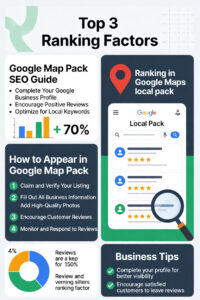
Google Uses Three Factors To Decide Who Gets In
Google has been surprisingly transparent about this. Local rankings come down to three things: relevance, distance (proximity), and prominence. Every ranking signal feeds into one of these three buckets.
Relevance is how well your listing matches what the person is searching for. Google looks at your business categories, your services, your description, and your website content to figure out if you are actually a good match for the query. This is the factor you have the most control over.
Proximity is how close your business is to the person searching. If someone is standing in downtown Tampa and searches “coffee shop,” Google is going to prioritize coffee shops in downtown Tampa. You cannot game this. You cannot SEO your way next to the searcher. But you can make sure Google understands where you actually operate, which matters more than people think.
Prominence is how well-known and trusted your business appears, both online and offline. Google evaluates this through reviews, links, citations, brand mentions, and the overall authority of your online presence. This is where the long game pays off.
If you have been making common local SEO mistakes, chances are you are weak in at least one of these three areas. Let’s fix each one.
Your Google Business Profile Is The Foundation
Your Google Business Profile (GBP) is not a set-it-and-forget-it listing. It is the single most important factor for Map Pack rankings. Industry surveys consistently show that GBP signals account for roughly 32% of all local pack ranking factors. Nothing else comes close.
Here is what a fully optimized GBP looks like:
Pick the right primary category. This is the single most impactful decision you will make on your profile. Don’t pick something generic when a specific option exists. If you are a personal injury attorney, your primary category should be “Personal Injury Attorney,” not “Law Firm.” Use secondary categories for everything else you offer.
Fill out every single section. Services, products, business description, Q&A, attributes. Use every character Google gives you. The more information you provide, the more queries Google can match you to. We covered this in detail in our local SEO checklist, which walks through the full optimization process step by step.
Post regularly. Google Business Profile posts are an underused feature. Weekly posts with updates, offers, or educational content tell Google your business is active and engaged. They also give you another surface area for relevant keywords.
Upload real photos. Not stock images. Real photos of your business, your team, your work, and your location. Geotagged photos are even better. Google can read the metadata, and it reinforces your location signals. Businesses with active photo libraries consistently outperform those with the default Google Street View image.
Keep your hours current. It sounds small, but incorrect hours erode trust with both Google and customers. Update for holidays. Update for seasonal changes. Keep it accurate.
Reviews Are The Ranking Signal Most Businesses Underinvest In
If you want to move the needle on Map Pack rankings faster than almost any other tactic, get more reviews.
Reviews are a direct signal of prominence. Google factors in the total number of reviews, your average rating, how recently the reviews were posted, and whether you respond to them. A business with 200 reviews but nothing in the last six months is weaker in Google’s eyes than a business with 80 reviews and a steady stream of new ones coming in every week.
Review velocity (how consistently you are getting new reviews) matters just as much as total count. This is why a one-time review push does not work. You need a system.
Here is what works:
Make it easy. Send customers a direct link to your Google review page after every transaction or engagement. Remove the friction. If they have to search for you to leave a review, most of them won’t.
Respond to every review. Positive ones, negative ones, all of them. When you respond to reviews, you are sending engagement signals to Google. And here is a quiet trick that works: naturally include your primary service and city in your responses. Something like “Thank you for choosing us for your home inspection in Vero Beach” gets crawled and indexed by Google.
Never buy reviews or use review generation services that incentivize fake feedback. Google’s spam detection has gotten aggressive, particularly after the August 2025 spam update. If you get caught, you lose everything.
NAP Consistency: Boring, Critical, Non-Negotiable
NAP stands for Name, Address, Phone Number. It needs to be identical everywhere your business appears online. Your GBP, your website, Yelp, Apple Maps, Bing Places, BBB, Facebook, industry directories, and anywhere else your business is listed.
“Main Street” versus “Main St.” might seem trivial. At scale, those inconsistencies create conflicting signals that confuse Google about which information is correct. And when Google is not confident in your business data, it is not going to put you in the Map Pack.
This is one of the most common local SEO mistakes we see when auditing businesses. Old phone numbers lingering on directories. Former addresses still listed somewhere. A business name that is slightly different on Yelp than it is on Google.
The fix is straightforward: audit every directory where your business appears, and make everything match exactly. It is tedious work, but it is foundational. If you want to use AI tools to speed up this kind of competitive research, our Claude SEO tools playbook walks through how to automate citation audits and gap analysis.
Your Website Still Matters (A Lot)
There is a misconception that the Map Pack runs entirely on your Google Business Profile and has nothing to do with your website. That is wrong. Google cross-references your GBP with your website’s content and authority to validate your listing. Your site acts as a supporting signal that reinforces everything in your profile.
Here is what matters on the website side:
Location-specific landing pages.
If you serve multiple cities or neighborhoods, each one needs its own page. Not a generic “Areas We Serve” list. Dedicated pages with unique content for each location. Google wants clarity about where you operate, and these pages provide it.
On-page SEO basics.
Your title tags, H1s, and meta descriptions should include your target city and primary services. Make it obvious to search engines where you are and what you do.
Schema markup.
LocalBusiness schema tells Google exactly what your business is, where it is located, what hours you operate, and what services you offer. It is structured data that makes Google’s job easier. When you make Google’s job easier, Google tends to reward you.
Mobile performance.
Local searches happen disproportionately on phones. If your site takes more than three seconds to load on mobile, you are losing both rankings and customers. This is not just a Map Pack issue. It is an everywhere issue.
Links And Citations Build Long-Term Authority
Backlinks still matter for local SEO, but the type of links that move the needle for local rankings are different from traditional SEO.
Local links from businesses, organizations, news outlets, and community groups in your area are significantly more valuable than random links from unrelated websites. A link from your local chamber of commerce, a sponsorship mention from a community event, or a feature in a regional publication carries real weight.
Citations (online mentions of your NAP information) on authoritative directories build trust signals over time. The core directories that matter: Yelp, Apple Maps, Bing Places, Facebook, BBB, Angi, Nextdoor, and whatever niche directories exist in your industry. For law firms, that includes platforms like Avvo, FindLaw, Justia, and Super Lawyers. For contractors, it includes HomeAdvisor and Thumbtack. For restaurants, it includes TripAdvisor and OpenTable.
The point is not to be on every directory that exists. The point is to be accurately listed on the directories that matter for your industry, with perfectly consistent NAP data.
What You Cannot Control (And How To Work Around It)
Proximity is the one factor you cannot directly influence. If a searcher is standing next to your competitor’s office, your competitor will have a proximity advantage for that specific search.
But proximity is not absolute. A business that is significantly stronger in relevance and prominence can outrank a closer competitor. This happens all the time in markets where one business has invested heavily in its GBP, reviews, content, and citations while the closer competitor has done nothing.
Service area businesses face a different version of this challenge. If you do not have a storefront or public-facing office, you can set up service areas in your GBP without displaying a physical address. Building location-specific content and generating reviews that mention your service areas helps extend your effective reach beyond your physical location.
The Behavioral Signals Google Is Watching
Google pays attention to what happens after your listing appears in search results. Click-through rate, phone calls initiated from the listing, direction requests, and website visits are all behavioral signals that indicate whether your listing is actually useful to searchers.
A listing that consistently gets clicked on, called from, and interacted with is telling Google that it is a relevant, helpful result. Over time, this creates a positive feedback loop. More engagement leads to better rankings, which leads to more engagement.
This is why everything about your listing needs to be compelling. Your business description, your photos, your review responses, your posts. Every element is either encouraging a click or discouraging one.
The Timeline: How Long Does This Actually Take?
Let’s be honest about expectations. Most businesses see initial movement in Map Pack rankings within 60 to 90 days of implementing a comprehensive local SEO strategy. Competitive markets like personal injury law, HVAC, or roofing in major metros can take four to six months to break into the top three.
The fastest levers are GBP optimization and review velocity. Getting your profile fully built out and establishing a consistent review generation system can produce visible improvements within 30 days. Link building and citation authority take longer to compound but create the most durable rankings.
There are no hacks that skip this timeline. Anyone promising overnight Map Pack results is either lying or using tactics that will get your listing suspended.
What To Do Right Now
If you have read this far and want to actually do something about your Map Pack visibility, here is where to start:
First, go claim and fully optimize your Google Business Profile if you have not already. Follow our local SEO checklist as your guide.
Second, set up a repeatable system for generating reviews. Make it part of your customer workflow, not something you remember to do every few months.
Third, audit your citations. Find every directory where your business appears and make sure the NAP information is exactly the same everywhere.
Fourth, look at your website. Do you have location pages? Is your schema markup in place? Are your title tags and H1s optimized for local keywords?
Fifth, start earning local links. Sponsor a community event. Get involved with your chamber of commerce. Contribute content to local publications. Build relationships that generate real, relevant backlinks.
Local SEO is not glamorous work. There is no single trick that unlocks the Map Pack. It is a system of consistent, compounding effort across your GBP, your reviews, your citations, your website, and your local authority.
The businesses in those top three spots are not lucky. They just started doing this work before you did. The good news is that you can start today.
If your local SEO feels like guesswork, or you are spending money on marketing without knowing what is actually working, we can help. At Foxtown Marketing, we build local SEO systems that connect marketing effort to actual business results, not vanity metrics.

Ethan Priest is a cofounder of Foxtown Marketing and the creative force behind everything visual. From digital ads and video to full brand refreshes, Ethan makes sure every piece of content looks sharp and fits the bigger marketing picture.
But Ethan’s not just a designer. He brings serious analytical chops to the table, with deep expertise in SEO, PPC, website optimization, and the data that ties it all together. He’s the guy who can build you a beautiful landing page and then tell you exactly why it’s converting (or not).
More recently, Ethan has become one of the team’s go-to specialists in AI marketing and Generative Engine Optimization (GEO), helping clients show up not just in traditional search results but in AI-generated answers and recommendations. As the way people find businesses continues to shift, Ethan is already ahead of the curve, making sure Foxtown’s clients don’t get left behind.
His background spans graphic design, motion graphics, and multimedia production, and he’s known for turning complex ideas into visuals that actually land. He works closely with the entire Foxtown team to make sure every project hits the mark and looks great doing it.
While many dream of being digital nomads, Ethan proudly calls himself a “digital slow-mad,” taking his time as he explores the world one country (and coffee shop) at a time, currently based in Lisbon. When he needs to recharge, you’ll find him nose-deep in a fantasy novel, chasing mountain trails with his camera, hunting for local art scenes, or experimenting with new animation techniques just for the fun of it.
Ethan lives by the belief that creativity isn’t just a job. It’s a way of life, and every adventure feeds the next project.