
TL;DR
- PPC (pay-per-click) marketing means you only pay when someone clicks your ad, making it one of the most accountable forms of advertising available
- Google Ads, Meta Ads, and LinkedIn Ads are the three platforms that matter most for most B2B businesses
- A good PPC marketing services provider handles strategy, setup, copywriting, bidding, and ongoing optimization, not just campaign “management”
- PPC works fastest when your landing pages and offer are already solid, it amplifies what’s working, it doesn’t rescue what isn’t
- Without proper tracking, you’re flying blind; call tracking and conversion data are non-negotiable
- Foxtown Marketing offers fractional CMO-level PPC oversight for B2B companies that want results, not just activity
What PPC Marketing Services Actually Mean
Let’s get the basics out of the way fast.
PPC stands for pay-per-click. You run ads on platforms like Google, Meta (Facebook and Instagram), LinkedIn, or Microsoft Ads, and you only pay when someone clicks. The model sounds simple. The execution is anything but.
Most businesses come to us after one of two experiences. Either they ran ads themselves, burned through their budget in two weeks with nothing to show for it, and swore off paid advertising forever. Or they hired someone cheap, got a monthly report full of impressions and click-through rates, and had no idea whether any of it was actually making money.
Both scenarios are common. Both are fixable.
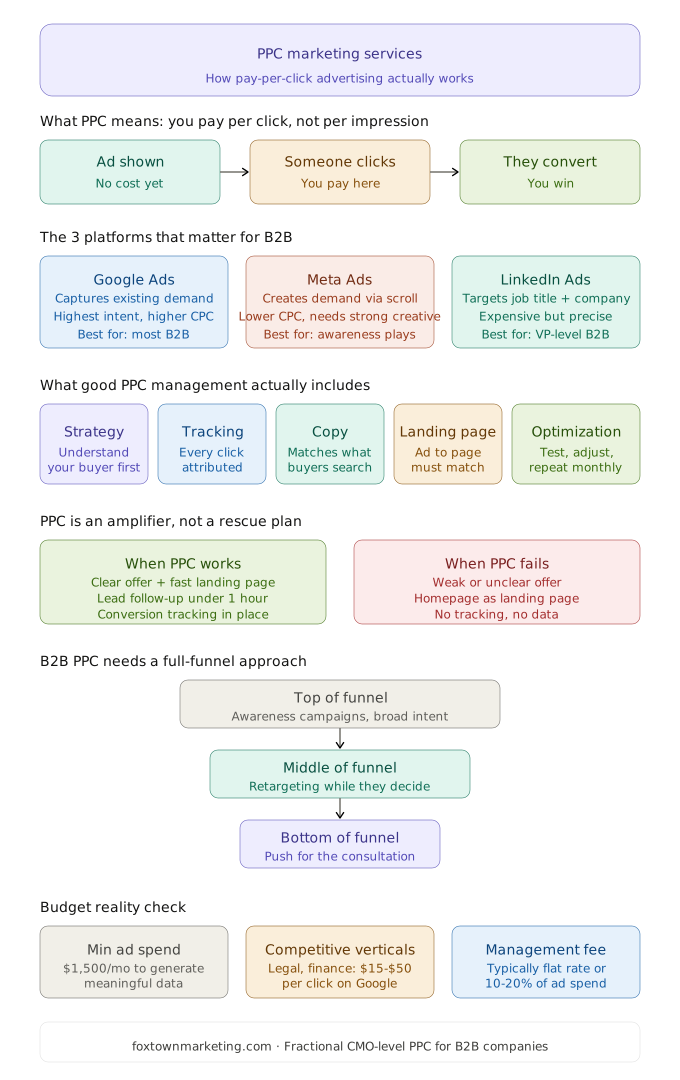
Professional PPC marketing services are not just “managing” a Google Ads account. They involve building a campaign structure that matches how your buyers actually search, writing ad copy that speaks to intent rather than just features, setting up conversion tracking so you know which clicks turn into leads, running split tests to find what resonates, and adjusting bids and budgets based on real performance data. It’s ongoing, analytical work. It takes time to do well, and it takes experience to do efficiently.
The Platforms That Matter
Not every platform makes sense for every business. Here’s a quick breakdown.
Google Ads is the workhorse. It captures demand that already exists. Someone searches “B2B marketing agency near me” or “fractional CMO for law firm” and your ad shows up. Because the intent is already there, conversion rates tend to be higher than on social. The downside is that competitive keywords can be expensive, especially in legal, finance, and healthcare.
Meta Ads (Facebook and Instagram) create demand rather than capture it. You’re interrupting someone’s scroll, which means your creative and targeting have to work harder. That said, Meta’s audience targeting is still remarkably precise, and for the right offer, it can generate leads at a fraction of the cost of Google.
LinkedIn Ads are expensive on a cost-per-click basis, but for B2B companies selling to specific job titles or company sizes, the targeting is unmatched. If you’re selling to VP-level decision makers at companies with 50 to 500 employees, LinkedIn puts you in front of exactly those people.
Microsoft/Bing Ads are worth mentioning because a lot of agencies ignore them. The volume is lower, but the competition is thinner and the audience skews older and higher-income. For many B2B advertisers, it’s a solid supplemental channel.
What Good PPC Management Actually Looks Like
Here’s what separates a PPC marketing services provider worth hiring from one who’s just going through the motions.
Strategy before setup.
Before anyone touches a campaign, there should be a conversation about your target customer, your offer, your margins, and what a lead is actually worth to you. If an agency skips this and jumps straight to “let’s get your campaigns live,” that’s a red flag.
Proper conversion tracking.
This is where most DIY campaigns fall apart. If your Google Ads account isn’t connected to your CRM, your call tracking platform, and your contact forms, you’re optimizing based on guesswork. We use CallRail and similar tools to close this loop for our clients. Every lead gets attributed. Every dollar gets accounted for.
Ad copy that matches intent.
The best-structured campaign in the world will underperform if the ads don’t speak to what the buyer actually cares about. Copy isn’t an afterthought. It’s a lever.
Landing page alignment.
If your ad says “Free Consultation for Law Firms” and it sends someone to your homepage, you’re losing conversions you already paid for. The message from ad to landing page has to be seamless. We talk about this more in our AI implementation for marketing post because the same principle applies to automated workflows: the handoff has to be clean.
Ongoing testing and optimization.
A PPC account that was set up six months ago and hasn’t been touched is almost certainly underperforming. Bid strategies need to be reviewed. Negative keyword lists need to be maintained. Ad variations need to be tested. Budget allocations need to be shifted based on what’s actually converting.
What PPC Marketing Services Won’t Fix
This part matters.
PPC is an amplifier. If your offer is strong and your landing page converts, paid traffic will pour fuel on the fire. If your offer is unclear or your website is slow and confusing, you’re paying to find out faster that something is broken.
Before investing heavily in PPC, make sure you have:
- A clear, specific offer with an obvious call to action
- Landing pages that load quickly and make it easy to take the next step
- A follow-up process for leads once they come in (a lead that waits 48 hours for a response is often a lost lead)
- Baseline conversion tracking in place
We go deeper on foundational marketing hygiene in our post on whether digital marketing is legit, which is worth a read if you’re newer to the space and trying to figure out what actually works vs. what’s just noise.
PPC for B2B vs. B2C: The Differences That Matter
The B2B sales cycle is longer. That changes how you approach paid advertising.
In B2C, someone searches for a product, sees your ad, clicks, and either buys or doesn’t. The feedback loop is fast. In B2B, especially for services selling at $5,000 and up per month, the buyer is doing research over days or weeks, comparing providers, and often making a decision by committee.
This means your PPC strategy for B2B needs to account for the full funnel. Top-of-funnel campaigns that build awareness and capture interest. Middle-of-funnel retargeting that keeps you visible while the prospect is deciding. Bottom-of-funnel campaigns that push for a consultation or demo.
It also means attribution gets complicated. Someone might click a LinkedIn ad, read three blog posts, see a retargeting ad on Google, and then convert through organic search a month later. If you’re only looking at last-click attribution, you’re undervaluing the early touchpoints that started the relationship.
This is one of the reasons we advocate for fractional CMO oversight of PPC, not just account management. An account manager optimizes the campaign. A strategist makes sure the campaign fits into the larger revenue picture. You can read more about what that kind of senior-level marketing leadership looks like at the Foxtown services page.
How Much Should PPC Cost?
Two separate costs come with PPC: the ad spend itself, and the management fee.
Ad spend goes directly to the platform. Management fees go to the agency or consultant running the campaigns. Some agencies charge a flat monthly rate. Others charge a percentage of ad spend, typically 10 to 20 percent. Neither model is inherently better; what matters is that the incentives are aligned and the reporting is transparent.
On ad spend, there’s no universal right answer, but generally speaking, most B2B campaigns need at least $1,500 to $3,000 per month in ad spend to generate enough data to optimize meaningfully. Below that threshold, you’re running on too small a sample size to draw reliable conclusions.
Budget also depends heavily on your vertical. If you’re in a competitive legal or financial market, expect to pay $15 to $50 per click on Google for high-intent terms. If you’re in a less competitive niche, you might get quality clicks for $3 to $8. A good PPC marketing services partner will give you realistic expectations based on your specific market before you commit to a budget.
For startups watching every dollar, our best marketing tools for startups post has some lower-cost ways to get traction while you’re building toward a paid ads budget.
Why Businesses Hire Foxtown for their PPC Marketing Services
We’re not a full-service ad agency with 200 employees and a junior account manager handling your account. We’re a fractional CMO firm that works with B2B companies doing $2M to $20M in revenue and takes a senior-level approach to paid advertising.
That means when you work with us on PPC, you get someone who understands your business model and your sales process, not just your keywords and click-through rates. We connect paid campaigns to revenue outcomes. We set up tracking properly from day one. We write the copy, build the strategy, and report on what actually matters.
We work with professional services firms, (law firm marketing is one of our specialties), and B2B companies across the country. If you want to talk about whether PPC makes sense for your business right now, and what it would take to run it properly, reach out here.
Foxtown Marketing is a fractional CMO firm serving B2B companies nationwide from Vero Beach, Florida. We specialize in digital marketing, B2B lead generation, and senior-level marketing strategy.

Ethan Priest is a cofounder of Foxtown Marketing and the creative force behind everything visual. From digital ads and video to full brand refreshes, Ethan makes sure every piece of content looks sharp and fits the bigger marketing picture.
But Ethan’s not just a designer. He brings serious analytical chops to the table, with deep expertise in SEO, PPC, website optimization, and the data that ties it all together. He’s the guy who can build you a beautiful landing page and then tell you exactly why it’s converting (or not).
More recently, Ethan has become one of the team’s go-to specialists in AI marketing and Generative Engine Optimization (GEO), helping clients show up not just in traditional search results but in AI-generated answers and recommendations. As the way people find businesses continues to shift, Ethan is already ahead of the curve, making sure Foxtown’s clients don’t get left behind.
His background spans graphic design, motion graphics, and multimedia production, and he’s known for turning complex ideas into visuals that actually land. He works closely with the entire Foxtown team to make sure every project hits the mark and looks great doing it.
While many dream of being digital nomads, Ethan proudly calls himself a “digital slow-mad,” taking his time as he explores the world one country (and coffee shop) at a time, currently based in Lisbon. When he needs to recharge, you’ll find him nose-deep in a fantasy novel, chasing mountain trails with his camera, hunting for local art scenes, or experimenting with new animation techniques just for the fun of it.
Ethan lives by the belief that creativity isn’t just a job. It’s a way of life, and every adventure feeds the next project.
