
TL;DR
- E-E-A-T stands for Experience, Expertise, Authoritativeness, and Trustworthiness. Google uses these signals to decide if your content deserves to rank.
- Most B2B websites fail on Trust and Authoritativeness, not on content quality.
- A checklist like this is not a one-time task. It is ongoing maintenance.
- The fastest wins are usually about who wrote the content, why they are qualified, and whether the site looks like a real business.
- We ran through this checklist on our own site. Here is what we found and what we are still fixing.
If you have spent any time reading about SEO in the past couple of years, you have heard the term E-E-A-T thrown around. Some people treat it like a secret algorithm unlock. Others wave it off as consultant jargon. The truth is somewhere in the middle, and it is a lot more practical than most people make it sound.
E-E-A-T stands for Experience, Expertise, Authoritativeness, and Trustworthiness. Google added the first E (Experience) in 2022 because the original EEAT framework was missing something obvious: there is a real difference between someone who read about a topic and someone who has actually done the thing. Both can be experts, but only one has experience.
This checklist walks through what good E-E-A-T looks like in practice. We also graded our own site because it felt dishonest to write a checklist we were not willing to apply to ourselves.
What E-E-A-T Actually Is (And What It Is Not)
Before the checklist, one important clarification. E-E-A-T is not a direct ranking factor in the traditional sense. Google does not give you an E-E-A-T score that moves you up or down in search results. What it does is inform the quality rater guidelines that Google’s human evaluators use to assess whether pages are high quality. Those evaluations feed into how the algorithm is trained and updated.
The practical implication: if your site reads like it was written by nobody, lacks any signal that a real person or real business is behind it, and gives visitors no reason to trust you, you are going to have a hard time ranking for competitive queries. That is especially true in professional services, health, legal, and finance categories, which Google calls YMYL (Your Money or Your Life) topics.
Law firm marketing, fractional CMO services, and anything that helps people make business or financial decisions all fall into that zone. Which is exactly why we pay attention to this.
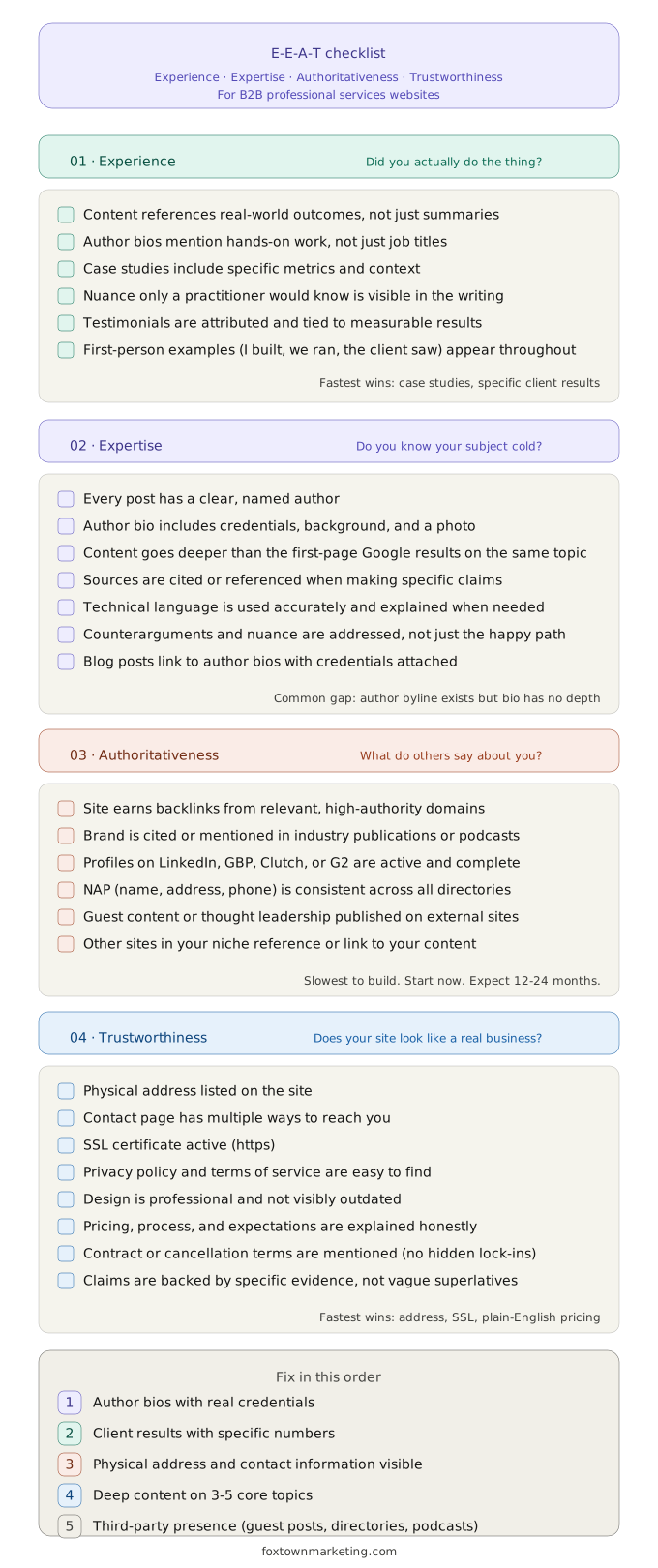
The E-E-A-T Checklist
Experience
Experience is about demonstrating that the person behind the content has actually done the thing they are writing about. It is not enough to summarize research. Google wants signals that you have first-hand knowledge.
Checklist items:
- Does the content reference specific real-world situations, outcomes, or examples from direct involvement?
- Do author bios mention relevant hands-on work, not just job titles?
- Are there case studies or client results with enough detail to feel real?
- Does the content reflect nuance that only someone who has done the work would know?
- Are testimonials specific, attributed, and tied to measurable outcomes?
How we did:
We publish client testimonials on the homepage with specific metrics (CAC from $340 to $127, 43% revenue growth year-over-year, pipeline that went from guesswork to three-month forecasting). The service pages reference specific tools and workflows like GA4 setup, HubSpot and CallRail implementation, and conversion tracking audits. Our law firm marketing content and Google Ads breakdowns are written by someone who has actually run the campaigns, not summarized them from a blog post.
Where we could improve: we do not have dedicated case study pages with full narrative write-ups. That is a gap we are aware of.
Expertise
Expertise is about credentials, knowledge depth, and whether the content demonstrates a real command of the subject. This one is where most B2B content falls flat because a lot of it is shallow by design. It is written to rank, not to actually teach anything.
E-E-A-T Checklist items:
- Is there a clear author on each piece of content?
- Does the author bio include credentials, relevant background, and a photo?
- Does the content go deeper than the obvious first-page Google results on the same topic?
- Are sources cited or referenced when making specific claims?
- Is technical language used accurately and explained when needed?
- Does the content address counterarguments or nuance, not just the happy path?
How we did:
The About section on the homepage goes into specific background: years working with professional services firms, experience as an angel investor watching marketing fail, running a full agency before pivoting to fractional CMO work. That kind of specificity matters.
The content itself tends to go deeper than surface-level SEO posts. Our call tracking comparison and CallRail vs. RingCentral breakdown go well past the “here are four options, they’re all great” format most blogs use.
Where we could improve: individual blog posts could link to author bios more consistently. Some posts have an author byline but no click-through to a profile with credentials attached.
Authoritativeness
Authority is about your reputation beyond your own site. It is what other credible sources say about you. This is the one you have the least direct control over, which is also why it is the most valuable signal when you have it.
Checklist items:
- Does your site earn backlinks from relevant, high-authority domains?
- Are you cited or mentioned in industry publications, podcasts, or roundups?
- Do you have a presence on authoritative third-party platforms (LinkedIn, Google Business Profile, Clutch, G2, etc.)?
- Is your business listed consistently across directories with matching NAP (name, address, phone)?
- Do other sites in your niche reference or link to your content?
- Have you contributed guest content or thought leadership to external publications?
How we did:
This is where most small B2B firms, including us, have honest room to grow. We have a solid LinkedIn presence and consistent business listings, but building true third-party authority is a slow game. We have been creating Quora posts, Scribd documents, and guest content as part of a long-term link-building approach. The fractional CMO content and law firm marketing work are targeting the kinds of queries that attract natural links from relevant sites.
Nobody should pretend this is a fast fix. Authority builds over 12 to 24 months with consistent effort.
Trustworthiness
Trust is the foundational layer. You can have experience, expertise, and even some authority, but if your site looks sketchy or gives people no reason to believe you are a real operation, none of it matters.
Checklist items:
- Is there a physical address listed on the site?
- Is there a real contact page with multiple ways to reach you?
- Does the site have an SSL certificate (https)?
- Are there clearly written privacy policy and terms of service pages?
- Is the design professional and up to date?
- Does the site clearly identify who owns and operates it?
- Are pricing, process, and expectations explained honestly?
- Are refund policies, contract terms, or cancellation policies mentioned?
- Are claims backed by specific evidence rather than vague superlatives?
How we did:
We have a physical address, a real contact form, SSL, and transparent pricing starting points on the homepage. The FAQ section answers the questions people actually have, including the uncomfortable ones like “why would I trust you after getting burned by another agency?” We are explicit about month-to-month contracts with easy exit clauses because burying that information is bad for everyone.
Where we could improve: a dedicated privacy policy page and terms of service that are easy to find would add a basic trust signal that some sites still overlook.
A Few Things That Cut Across All Four Categories
Some E-E-A-T checklist signals are hard to slot into just one category.
Content freshness matters. A blog post from 2019 that has not been touched tells Google and your reader that nobody cares about it anymore. Audit your older content regularly. Update statistics, check links, and refresh anything that has aged poorly.
Consistency of voice matters more than people realize. Sites that feel like they were written by five different people or clearly assembled by an AI content farm score poorly on trustworthiness even if no single piece of content is bad. Readers feel it even if they cannot name it.
Internal linking connects your authority signals across the site. A piece on Philadelphia law firm marketing and a piece on Chicago law firm marketing should link to each other and to the pillar content that anchors the topic. This is not just a UX nicety. It is how Google understands that you have depth on a subject, not just a single lucky post.
What To Fix First
If you are staring at this checklist and feeling overwhelmed, prioritize in this order:
- Author bios with real credentials. This is the fastest trust fix and the most overlooked one. Every piece of content should have a named author with a real bio.
- Client results with specifics. Replace vague testimonials with ones that include real numbers and context.
- Physical address and contact information. If you are hiding who you are and where you are, Google notices.
- Content depth on your core topics. Pick three to five subjects you actually want to rank for and go deeper than everyone else on the page.
- Third-party presence. Guest posts, directory listings, podcast appearances, industry citations. It takes time but there are no shortcuts here.
E-E-A-T is not a campaign you run. It is a standard you maintain. The good news is that most of the work aligns directly with being a better business, not just a better-ranked one. Transparent pricing, real credentials, honest case studies, and content written by people who actually know the subject matter are things your buyers care about, not just Google’s crawlers.
If you want help auditing your own site or figuring out where E-E-A-T checklist items are costing you rankings, let’s talk.
Related reading: What Is a Fractional Law Firm CMO? | Small Law Firm Marketing: What’s Wasting Your Money | Google Ads For Law Firm Marketing | The Best Call Tracking Solutions in 2026

Ethan Priest is a cofounder of Foxtown Marketing and the creative force behind everything visual. From digital ads and video to full brand refreshes, Ethan makes sure every piece of content looks sharp and fits the bigger marketing picture.
But Ethan’s not just a designer. He brings serious analytical chops to the table, with deep expertise in SEO, PPC, website optimization, and the data that ties it all together. He’s the guy who can build you a beautiful landing page and then tell you exactly why it’s converting (or not).
More recently, Ethan has become one of the team’s go-to specialists in AI marketing and Generative Engine Optimization (GEO), helping clients show up not just in traditional search results but in AI-generated answers and recommendations. As the way people find businesses continues to shift, Ethan is already ahead of the curve, making sure Foxtown’s clients don’t get left behind.
His background spans graphic design, motion graphics, and multimedia production, and he’s known for turning complex ideas into visuals that actually land. He works closely with the entire Foxtown team to make sure every project hits the mark and looks great doing it.
While many dream of being digital nomads, Ethan proudly calls himself a “digital slow-mad,” taking his time as he explores the world one country (and coffee shop) at a time, currently based in Lisbon. When he needs to recharge, you’ll find him nose-deep in a fantasy novel, chasing mountain trails with his camera, hunting for local art scenes, or experimenting with new animation techniques just for the fun of it.
Ethan lives by the belief that creativity isn’t just a job. It’s a way of life, and every adventure feeds the next project.